Botox · August 11, 2026
The Evidence-Based 4-Step Skincare Routine Dermatologists Actually Recommend
A simple, science-backed approach to cleansing, antioxidants, retinoids, moisturizing, and daily sun protection
Skincare has become increasingly complicated. Search for the “perfect” routine and you’ll find 7-step, 10-step, and even 15-step regimens filled with toners, essences, serums, masks, exfoliants, and specialty treatments. While some of these products can have a place in a routine, healthy skin does not require a bathroom cabinet full of products. From a dermatology perspective, a simple routine built around a few well-studied ingredients can address many of the most common goals, including maintaining the skin barrier, preventing premature skin aging, improving pigmentation, supporting collagen, and managing acne.
Skin biology hasn’t changed.
What has changed is skincare marketing.
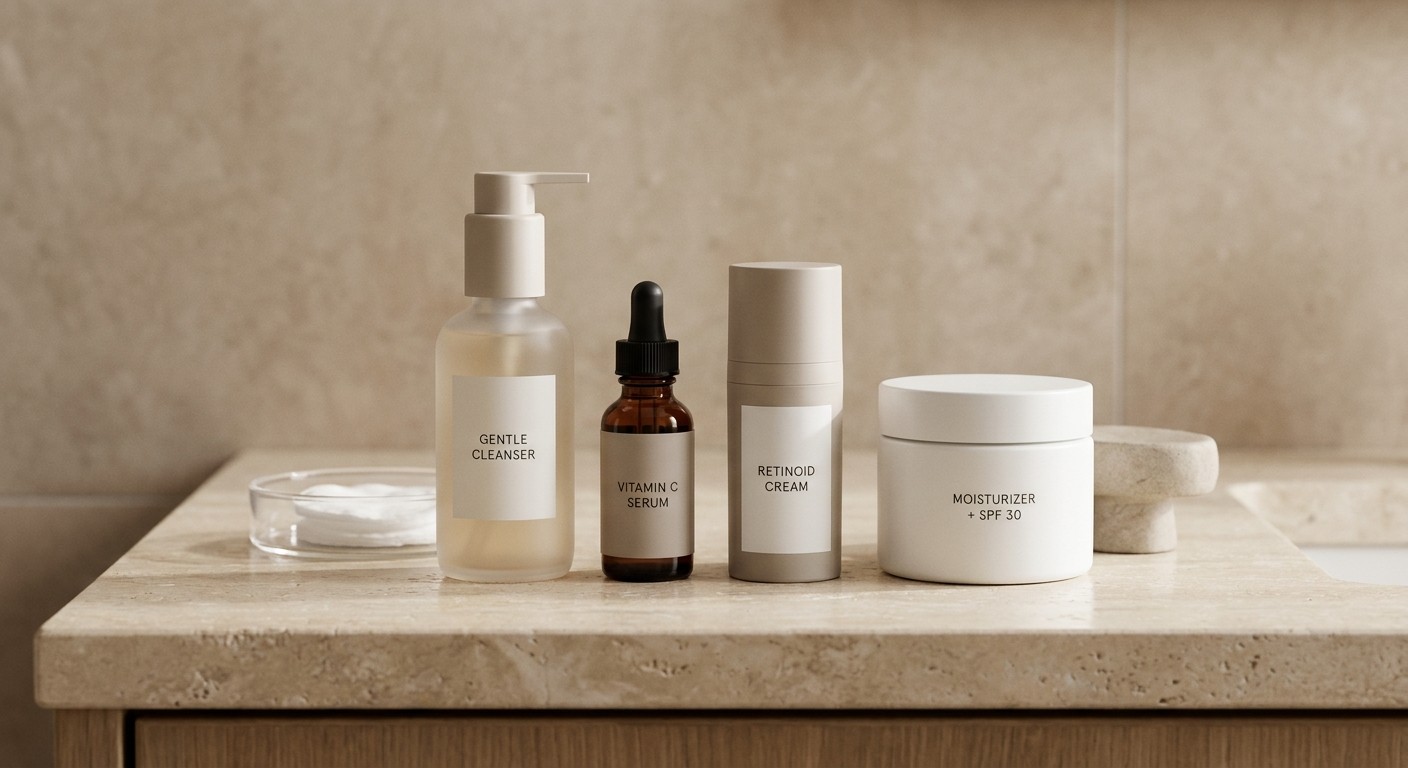
When we look at skincare through the lens of scientific evidence rather than trends, most people can build an effective routine around four core steps:
- Cleanser
- Vitamin C in the morning
- Retinoid in the evening
- Moisturizer and broad-spectrum sunscreen
Here’s why each one matters.
Step 1: Cleanser — Protect the Skin Barrier
The purpose of cleansing is straightforward: remove excess oil, sweat, sunscreen, makeup, debris, and environmental pollutants from the surface of the skin.
More cleansing, however, does not necessarily mean cleaner or healthier skin.
Cleansers contain surfactants that help break down and remove oils. The problem is that these ingredients cannot perfectly distinguish between unwanted excess oil and the natural lipids that form part of your skin’s protective barrier.
Cleansing too frequently or using harsh products can leave the skin feeling tight, dry, irritated, or increasingly sensitive. Once the skin barrier becomes compromised, even products that were previously well tolerated may begin to sting or cause redness.
Dermatologist tip:
- Dry or sensitive skin: You may only need water in the morning followed by a gentle cleanser at night.
- Normal or combination skin: A mild cleanser once or twice daily is usually sufficient.
- Oily or acne-prone skin: A cleanser containing a gentle exfoliating ingredient may be helpful, but avoid aggressively stripping the skin.
The goal is not to remove every trace of oil. It is to cleanse the skin while preserving the barrier that keeps it functioning properly.
Step 2: Vitamin C — Morning Antioxidant Protection
Vitamin C is one of the most extensively studied antioxidant ingredients used in skincare.
During the day, your skin is exposed to ultraviolet radiation, pollution, and other environmental stressors that can contribute to oxidative damage. Antioxidants help neutralize some of the free radicals involved in this process.
Topical vitamin C may help with:
- Antioxidant protection against environmental stress
- Supporting collagen production and stability
- Improving the appearance of uneven pigmentation
- Mild brightening of the skin
- Complementing the protection provided by sunscreen
Vitamin C is generally most useful in the morning, when the skin is about to encounter UV exposure and environmental pollutants.
Apply it after cleansing and before moisturizer and sunscreen.
Not every vitamin C product is formulated equally, and stronger is not always better. If your skin is sensitive, introducing it gradually or choosing a lower-strength formulation may improve tolerance.
Step 3: Retinoids — Evening Repair and Collagen Support
If there is one category of skincare ingredients dermatologists consistently return to for long-term skin health, it is retinoids.
Retinoids are derivatives of vitamin A and have decades of research behind their use in dermatology. Depending on the formulation and strength, they can be used to address both acne and visible signs of skin aging.
With consistent use, retinoids can help:
- Stimulate collagen production
- Improve the structure and thickness of the skin
- Reduce the appearance of fine lines
- Improve uneven pigmentation
- Promote more even skin-cell turnover
- Prevent and treat acne
For someone looking to choose a single active ingredient for long-term skin maintenance, a retinoid is often one of the most worthwhile options.
Retinoids are generally applied in the evening after cleansing.
They can cause dryness, flaking, or irritation when first introduced, so there is no need to begin with nightly use. Starting two or three evenings per week and gradually increasing frequency can make the adjustment period much easier.
A moisturizer can also be applied before or after the retinoid if additional barrier support is needed.
Step 4: Moisturizer + Sunscreen — Barrier Support and Daily Protection
Moisturizer
Moisturizers help the skin retain water and maintain an effective protective barrier.
Rather than simply “hydrating” the skin from the outside, a good moisturizer helps reduce transepidermal water loss and supports the lipid barrier that keeps moisture from escaping.
This becomes especially important when using active ingredients such as retinoids.
Regular moisturizer use can:
- Support the skin barrier
- Reduce water loss
- Improve dryness and irritation
- Increase tolerance to active skincare ingredients
- Help the skin feel smoother and more comfortable
Choose the texture based on your skin type and preference:
- Dry skin: Creams, balms, and ointments
- Normal or combination skin: Creams or lightweight lotions
- Oily skin: Gels and lightweight lotions
For most people, moisturizer can be used both morning and evening.
Sunscreen — SPF 50+ Broad Spectrum
If your goal is preventing premature skin aging, pigmentation, and UV damage, sunscreen is arguably the most important product in your routine.
Ultraviolet radiation contributes to collagen breakdown, uneven pigmentation, wrinkles, and the development of skin cancer over time.
Daily sunscreen helps:
- Prevent UV-related pigmentation
- Reduce cumulative sun damage
- Preserve collagen
- Slow the development of visible photoaging
- Reduce the risk of skin cancer
Look for a sunscreen that provides:
- Broad-spectrum protection against UVA and UVB
- SPF 50 or higher
- A texture you are comfortable applying generously every day
One of the biggest problems with sunscreen is not necessarily the SPF on the bottle, but how much people actually apply.
Most people use less sunscreen than the amount used during laboratory SPF testing. Choosing SPF 50 or higher provides additional protection in real-world conditions where application may be imperfect.
And remember: the best sunscreen is ultimately one you will use consistently.
Final Thoughts: Keep Your Skincare Routine Simple
An effective dermatologist-recommended skincare routine does not need 10 different products.
For most people, consistency with a few proven ingredients will accomplish far more than constantly changing products based on the latest skincare trend.
A simple routine might look like this:
Morning
- Cleanse
- Vitamin C
- Moisturizer
- Broad-spectrum SPF 50+ sunscreen
Evening
- Cleanse
- Retinoid
- Moisturizer
Additional products can certainly be added for specific concerns such as acne, rosacea, pigmentation, eczema, or other skin conditions. But they should be additions to a strong foundation rather than replacements for one.
The skincare industry will continue to introduce new ingredients, trends, and routines.
Skin biology won’t.
Start with the fundamentals, choose products you can tolerate, and stay consistent.

About the Author
Dr. Danny Guo, MD
BSc (Hons) · MD · FRCPC Dermatology · Fellowship in Mohs Micrographic Surgery & Dermatologic Oncology
Dr. Danny Guo is a board-certified dermatologist and fellowship-trained Mohs surgeon practicing in Calgary, Alberta. He completed his medical degree at the University of Calgary, his dermatology residency at the University of British Columbia, and advanced fellowship training in Mohs micrographic surgery and complex reconstruction at the University of Toronto. In addition to his clinical practice, Dr. Guo is a national speaker, clinical researcher, and digital educator with over 1.3 million followers across social media platforms.
Learn more about Dr. Danny Guo →Professional Inquiries
Professional & Media Inquiries
For media inquiries, expert commentary, speaking opportunities, sponsorships, collaborations, or general professional inquiries, please contact Dr. Guo's team.